

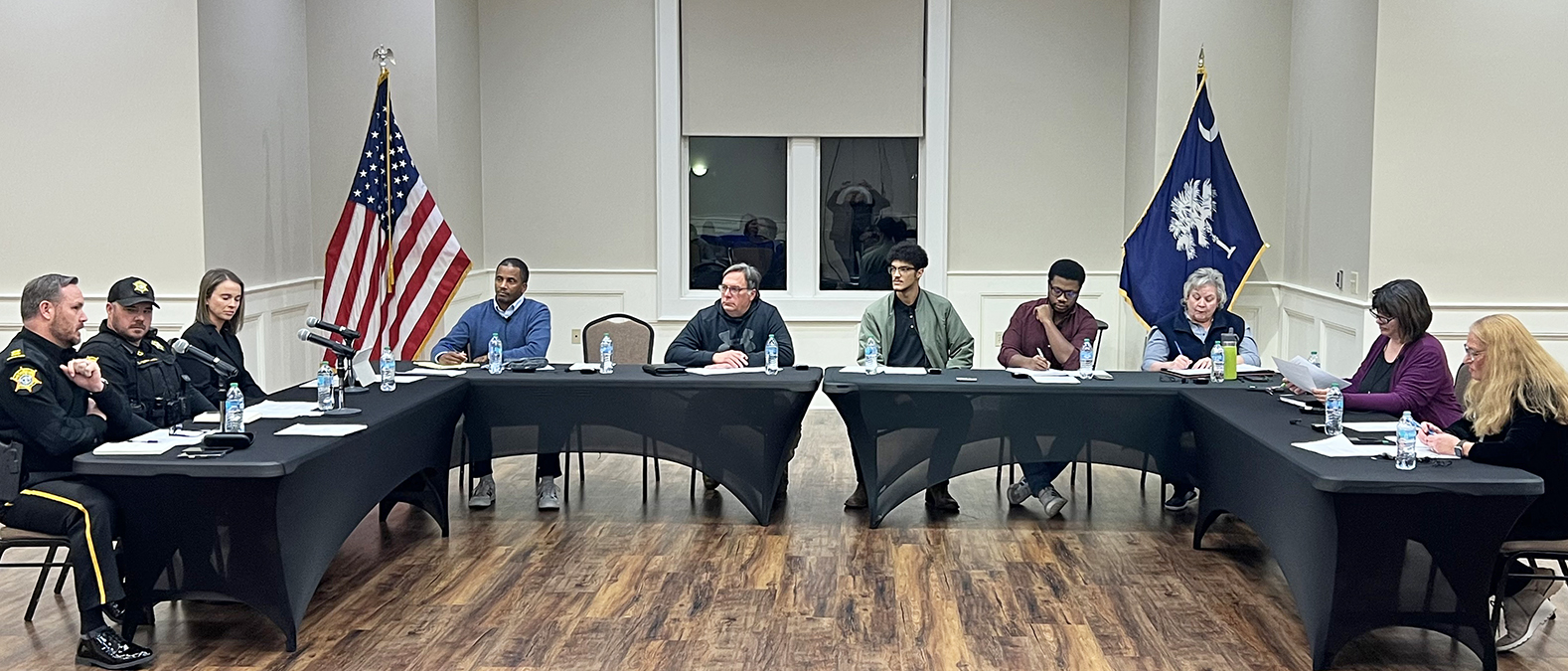
BLYTHEWOOD — During a Feb. 26 meeting, the Town’s newly appointed ad hoc safety committee finalized and ranked a set of recommendations they will present to town council to help prevent the large-scale teen disruptions in Doko Park that led town council to temporarily shut down nighttime events last year.
The committee consists of two sheriff’s deputies and eight citizens, including a high school student. They applied for the committee and were appointed by Councilwoman Trish Hovis, authorized by council to organize the committee.
“We’re in the final stretch,” committee chair and Blythewood High School student Zaire Collins told the group as members began working through their final draft.
The committee’s work comes after a series of incidents in which hundreds of teens disrupted Doko Park during nighttime family-friendly events two summers ago. On several occasions, large groups of teens would burst into massive fights during the events, sometimes in front of sheriff’s deputies on scene.
The volunteer ad hoc committee has been tasked with suggesting ways to curtail the teen disruptions so citizens can again enjoy nighttime park events without the threats of fighting and other teen drama.
The committee’s recommendations will be presented by the committee to Blythewood Town Council for a vote on April 27.
The following are the committee’s prioritized recommendations:
Threat Assessment
- Youth Supervision Policy (curfew)
- Registration and Wristband Requirement
- Organizational Coordination
- Parking Assistance
- Threat Assessment
Committee members agreed the threat assessment should be the town’s first priority, with council urged to review and implement its recommendations.
“One of the biggest concerns was the threat of any possible violent engagements that we’ve seen in the past,” Deputy Sloan Simpson said.
“It is the threat assessment that most directly addresses the type of violence that led to the shutdown of nighttime park events,” said Simpson.
Committee member Cal Thomas added that public confidence depends on it.
“If they [council] don’t accept that recommendation, then I probably will not bring my family back,” Thomas said. “And I think most families will feel that way.”
But only the committee knows what the assessment targets are. At the last meeting of the committee, the agenda included an executive session to address assessment threats.
Open government attorney Jay Bender, who represents the S.C. Press Association, advised ahead of the meeting that there was no exception allowed under the Freedom of Information Act for an executive session to discuss threat assessment.
Nevertheless, Hovis moved forward with the executive meeting, siding with the Richland County Sheriff’s Department’s attorney who, she said, suggested the meeting be closed to the public, and the town’s Attorney Pete Balthazor approved it.
Hovis said it was such a high level security meeting that only the committee, including the high school student, should be privy to it, not the Town’s citizens.
“The South Carolina open meetings law allows, but does not require, a meeting closed to the public for “Discussion regarding the development of security personnel or devices.” Bender said. “The stated purpose of this closed meeting seems to indicate a discussion of a different matter. Simply because the sheriff’s department requested that the public be excluded does not change the law.”
Youth Supervision Policy (Curfew)
The Youth Supervision Policy is basically a curfew for minors that would be created by ordinance. It would stipulate that a 7 p.m. curfew would be applicable to minors at any large (100 or more attendance) town event. The Town would be the entity to enforce the curfew. If that enforcement is ignored, a Sheriff’s deputy can then be called to issue a ticket for trespassing.
“We don’t see anything positive coming out of the minors being in the park alone after 7 p,m.” Cobblestone resident Shelby Russell said.
Registration and Wrist Band Policy
Much of the evening’s discussion focused on how to control who attends large events.
“A key recommendation is a system requiring event registration paired with wristbands to control access,” said Russell. “The wristbands and the registration, to me, go hand in hand,” she said. “There’s no point in having registration if you don’t have wristbands.”
Russell, an attorney who lives in Cobblestone Park neighborhood, suggested that all who attend the event must register through Eventbright. Registration is accomplished through a web application using a drivers license number. Upon entering the park and showing ID, registered attendees will be given a wrist band to wear Attendees who enter the park without a registration number, can show their driver’s license to receive a wristband, but might have to wait in a longer line. Youths without drivers license accompanied by an adult who is registered or presents a valid drivers license will be issued a wristband.
Youths not with an adult and without a drivers license or some form of state id will be turned away.
The committee discussed setting a threshold for attendance – potentially around 150 attendees.
Under the proposal, attendees could register in advance or check in at the event. The goal is to ensure accountability — particularly for minors.
But even that raised concerns.
“I don’t know that I would feel terribly comfortable putting my driver’s license number… into a system,” said Katherine Porter, pointing to privacy issues at the risk of discouraging attendance.
Porter also raised concerns about cost, staffing and cleanup, noting discarded wristbands could create additional work.
“The concept is simple: no wristband, no access,” said Simpson.
Committee members acknowledged the approach would slow entry and add costs, but said safety outweighs convenience.
“But if we’re registering, they need wristbands,” Simpson said. “We need to be able to identify this person is registered and they can be here at this event.”
“There is no safe event that you can access quickly,” Russell said, comparing the process to security measures at large public events like festivals and football games.
The group also emphasized the need to funnel attendees through designated entry points — another change from past events, where crowds could enter from multiple directions.
“You have to come in through the entrance,” Russell said. “Everybody has to come in the same way.”
Organizational Coordination
The committee also recommended stronger coordination with local organizations who volunteer— including businesses, churches and civic groups — to support events.
Members suggested these volunteers could help with operations such as entry points and general oversight.
“If they can advertise their organization on t-shirts, etc. as they’re volunteering… they’ll eat that up,” Russell said, referring to potential partnerships with community groups.
Councilwoman Trish Hovis agreed the approach could broaden participation.
“That’s a great idea,” she said.
The committee revised the language from “business coordination” to “organizational coordination” to reflect a wider pool of potential partners.
Parking assistance
Parking assistance ranked last among the committee’s priorities, described largely as a “quality of life” issue rather than a core safety measure.
“I think it’s nice to have,” one member said during discussion.
Still, members noted that better organization — including trained parking volunteers and clear signage — could help reduce confusion and improve traffic flow during large events.
During the meeting, the committee also added a recommendation for controlled access points, including temporary fencing around event areas.
Additional Measures
“That way we have somewhere to check that somebody’s registered,” Deputy Simpson said.
Members emphasized that limiting entry points would help prevent people from bypassing security by entering from areas such as the railroad crossings.
The committee also discussed conducting a trial run of the new policies at a smaller event, such as a movie night, before larger gatherings resume.
“I think a good movie in the park would probably be a good trial run,” Simpson said.
An after-action review would follow, allowing officials to gather data and public feedback.
“That way we can kind of look at how these things went,” Hovis said.
What comes next
Throughout the meeting, members repeatedly emphasized that their role is to offer guidance — not final decisions – to council.
“These are just recommendations,” Collins said.
For a town eager to safely bring back community events, those recommendations could shape what the future of Blythewood’s park looks like — and how residents experience it.